
15 September 2026
Bathroom Noise In Derby Homes: Soundproofing Pipes, Floors And Walls In Terraces, Semis And Flats
There is no other room in the house where you deliberately push several hundred litres of water through the structure every single day. A bath takes around eighty litres to fill. A ten minute shower at twelve litres a minute is nearer a hundred and twenty. All of that arrives under pressure through pipes clipped to timber, and leaves down a stack that is very often fixed to the wall you share with next door. Add a pump, an extractor fan and somebody walking across a tiled floor above your head, and the arithmetic stops being surprising. Derby’s housing stock makes it worse than average: rows of Victorian and Edwardian terraces across Normanton, Peartree and Rose Hill where the bathroom was squeezed into a back bedroom decades after the house was built, and thousands of 1930s semis where the first-floor bathroom sits directly over a living room. Almost all of it is fixable, and almost all of it is only cheap to fix while the room is already in pieces.
Why The Bathroom Is The Loudest Room In A Derby House
Noise reaches you two ways, and they need completely different answers. Airborne noise is what you would expect: voices, the shower running, the radio. It travels through air, so it is stopped by mass and by sealing gaps. Structure-borne noise is different. It starts as a physical knock or vibration, gets into the timber or the masonry, and comes out somewhere else in the house as sound. Footsteps, banging pipes and a pump humming through a cupboard wall are all in this category, and adding mass to a wall does very little about them.
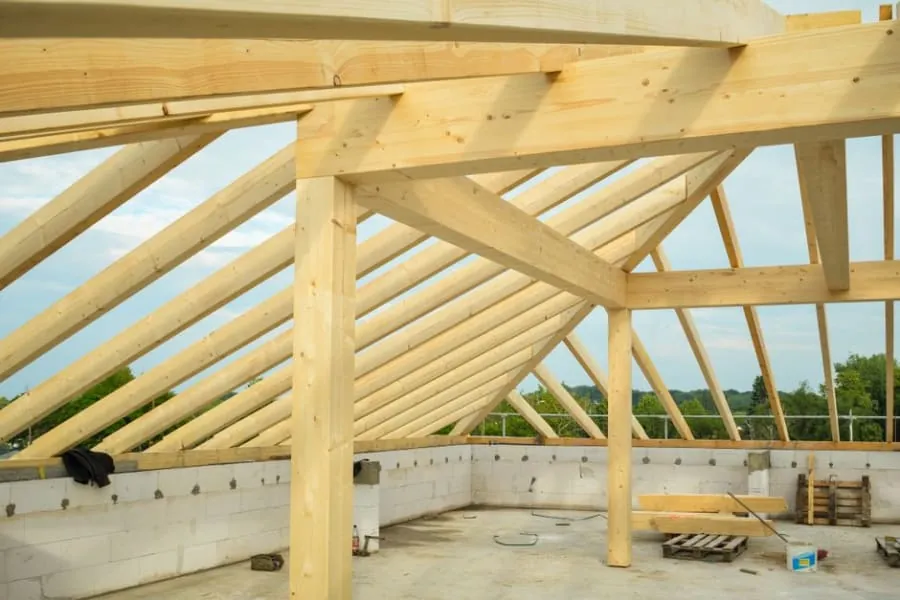
A bathroom is unusual because it generates both at once, and because nearly everything in it is hard-fixed to the structure. The pipes are clipped to joists. The stack is bracketed to brickwork. The bath sits on feet bearing straight onto the floor. Tiles turn the room into a reflective box that makes every splash sound louder from inside as well. When we plan a bathroom installation in Derby, the noise decisions get made at first fix, before a single board goes back down, because that is the only point where any of it is accessible.
People come to us looking for the product that makes a bathroom quiet. There isn’t one. There are five or six separate noise paths, each with its own cure, and the sensible approach is to work out which ones actually keep you awake and spend the money there.
Banging, Ticking And Hammering: What The Pipes Are Doing
Pipe noise splits into two distinct complaints that get muddled together constantly, and they have nothing to do with each other.
Water Hammer
This is the loud bang, usually on the way to the bathroom and usually a second after something shuts off. A modern quarter-turn tap or a washing machine solenoid closes in roughly a tenth of a second. The water behind it is still moving, it has nowhere to go, and the pressure spikes hard enough to make the pipe physically jump. What you hear is the pipe striking a joist, a notch or a badly spaced clip. Severn Trent, like every water company, has to deliver a minimum of seven metres head at the boundary, and plenty of Derby streets run comfortably above that, which means there is real energy behind the surge.
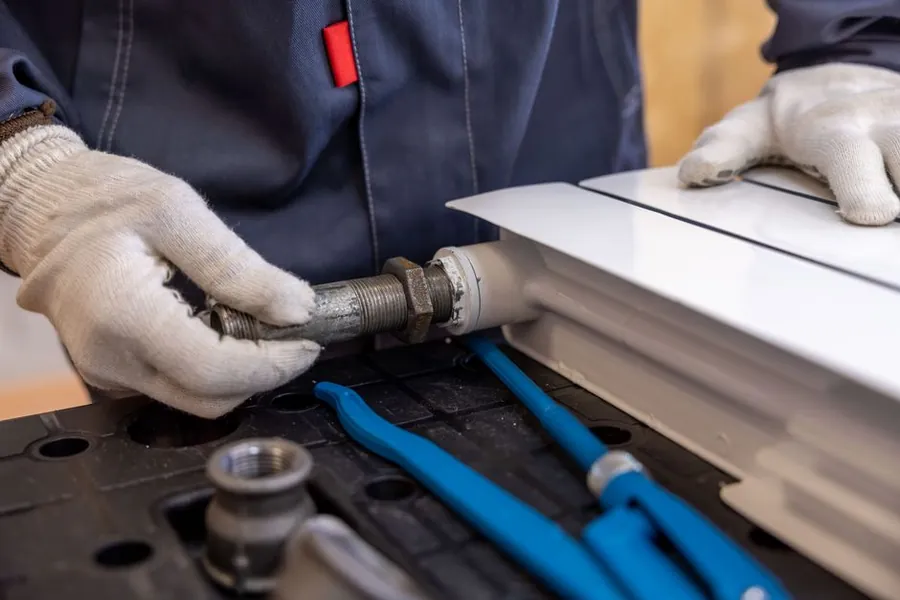
The cure is threefold: a shock arrestor fitted close to the fast-closing valve to absorb the surge, clips at sensible centres so the pipe cannot move in the first place, and a felt or foam sleeve wherever a pipe passes through a notch. If every outlet in the house hammers rather than just one, the incoming pressure is the problem and a pressure reducing valve on the main is the better answer.
The Ticking That Starts After The Shower
Different noise, different cause. Copper expands by about 0.017mm for every metre of pipe for every degree it warms up. Take a three metre run from cold mains to hot and you get roughly two millimetres of movement. That is enough to make a pipe drag against a joist notch, and the tick, tick, tick you hear is that drag releasing in small jumps.
Plastic is far worse. Polybutylene moves something like eight times as much for the same temperature change, so the same three metre run can shift fifteen millimetres or more. That is why a house re-plumbed in plastic in the 1990s often ticks more than the copper it replaced. The fix is not to clamp it harder, which only moves the noise somewhere else. It is to let the pipe slide, with a plastic-lined clip and a sleeve at every notch, and to give a long run a gentle set rather than a dead straight shot between two fixed points.
Waste Pipes, Soil Stacks And The Party Wall
This is the one that causes arguments with neighbours, and it is a Derby speciality because of how the terraces were adapted. When outside WCs came indoors and back bedrooms became bathrooms, the stack had to go somewhere, and it very often ended up running against or near a party wall. In a lot of Victorian terrace building, that party wall is a single brick thick, and in the cheaper speculative rows it can be less. Brick is excellent at conducting a vibration from one house to the next.

The material matters more than people expect. The original cast iron stack was heavy and stiff, so it soaked up the energy of water falling down it. Standard uPVC is thin and light, which makes it very good at turning that same falling water into sound and radiating it into the room and the wall. If your terrace had its stack swapped for plastic at some point and the noise got worse, you have found the reason.
There are three ways to sort it, and they stack up. Use a mineral-filled acoustic waste pipe rather than standard uPVC, which is the neatest answer if the run is being replaced anyway. Wrap the existing run in a mass loaded barrier before boxing it in, which is cheap and effective. Then box it with acoustic plasterboard on framing that does not touch the stack itself, because a rigid bracket straight into the party wall undoes most of the good work. That last detail is the one that gets skipped.
Footfall Overhead: The First-Floor Bathroom Floor
Impact noise is the complaint we hear most from people in Derby’s interwar semis, where the bathroom sits over a living room or a bedroom. Somebody walks across the tiles at seven in the morning and the whole ceiling below announces it.
Packing insulation between the joists barely touches this, which surprises people every time. Insulation absorbs airborne sound in the void, which is genuinely useful for voices and a running shower, but footfall is travelling through the joists as a physical impulse. The air gap is not the route. Tiling makes it worse, because a rigid tile bedded on ply bedded on joists is an efficient way of turning a footstep into a drum beat downstairs.
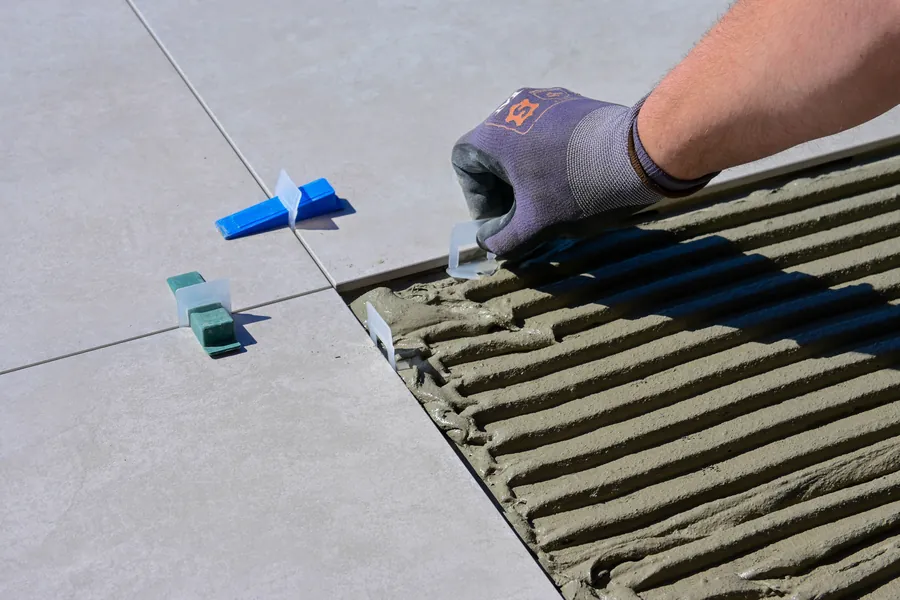
What does work is decoupling, meaning putting something soft into the path so the impulse cannot travel straight through. From above, that is a resilient layer laid over the joists with an acoustic deck on top, so the walking surface never touches the structure directly. From below, it is resilient bars fixed across the joists with a second layer of acoustic plasterboard hung off them, which is more disruptive because it means taking a ceiling down and redecorating, but it is the more effective of the two.
Two small things to do while the floor is open. Sit the bath feet on rubber pads rather than straight onto the deck, and leave the bath panel and the tiled upstand a hair clear of the floor with a flexible sealant rather than grouting them solid. Both cost almost nothing and both stop the bath acting as a drum skin.
Pumps, Fans And The Drone You Stop Being Able To Unhear
Continuous noise behaves differently from a bang. You stop noticing it during the day and then it keeps you awake.
Shower pumps are the main culprit. A twin impeller regenerative pump is not a quiet device, and most of what you hear is not the pump itself but the pump’s vibration going into whatever it is bolted to. Sitting one on an airing cupboard shelf that is fixed to a bedroom wall is the worst possible arrangement, and it is extremely common. Put it on an anti-vibration mat, use braided flexible hoses on both the inlet and the outlet so there is no rigid connection to the pipework, and keep it off any surface that shares a wall with a bedroom. If you are still deciding whether you need a pump at all, our piece on weak shower pressure in Derby homes goes through the alternatives first.
Extractor fans are the other one. The regulations ask for fifteen litres per second from an intermittent bathroom fan, and a cheap axial unit sitting in the ceiling will hit that while sounding like a hairdryer. An inline centrifugal fan mounted in the loft, ducted to a plain grille in the ceiling, moves the motor away from the room and typically lands somewhere around half the perceived loudness at the grille. Duct it in rigid pipe rather than the flexible concertina stuff, which both throttles the airflow and rattles. The upgrade costs a few hundred pounds and it is the single change people notice most.
Flats And Conversions: Where The Rules Actually Bite
Everything above is voluntary in a house. Nobody is going to inspect it. The picture changes if you live in a flat or a converted building, and Derby has a fair number of both, including the mill and warehouse conversions around the city centre and along the Derwent corridor.

Approved Document E, the building regulations guidance on resistance to the passage of sound, sets numbers for walls and floors between separate dwellings. Purpose-built flats are expected to reach 45 dB for airborne sound and no more than 62 dB for impact sound on a separating floor. Where a building has been converted into flats, the bar is slightly lower at 43 dB and 64 dB, on the basis that you are working with what the original structure gives you. There is also a much less well known section covering walls and floors inside a single dwelling, which asks for 40 dB between a WC and the rooms around it, and it is one of the most commonly missed requirements in a loft conversion or a new en-suite.
The part that catches leaseholders out has nothing to do with building control. A great many flat leases include a clause requiring floors to be carpeted, or to meet a stated impact rating, and swapping a carpeted bathroom for tiles can breach it regardless of how well the job is done. Read the lease before you commit to the floor finish. If a genuine dispute is already running, a member of the Institute of Acoustics can measure what is actually happening rather than everyone guessing, and the government guidance on resolving neighbour disputes sets out the sensible order to do things in before anyone involves the council.
What The Noise Work Adds To A Derby Bathroom Refit
Here is the honest version of the pricing, and why the decision belongs at the planning stage rather than after the tiler has gone.
Re-clipping and sleeving the accessible pipework is usually £150 to £350, because it is labour on pipe that is already exposed. A shock arrestor supplied and fitted is around £70 to £130 per point. Acoustic lagging on a soil stack before it gets boxed in runs £150 to £300 depending on the length. Acoustic mineral wool between the floor joists is typically £250 to £450 on a bathroom of normal size. An inline loft fan with rigid ducting instead of a ceiling axial adds £200 to £400. Anti-vibration mounting and flexible hoses on a pump is £80 to £150.

The two larger items are the floor and the ceiling. A resilient layer with an acoustic deck over it comes in around £45 to £70 per square metre supplied and fitted, so on a four square metre bathroom that is a couple of hundred pounds. A decoupled ceiling in the room below, using resilient bars and a second layer of acoustic board, is £45 to £75 per square metre plus making good and redecorating that room, which is where the cost actually lands.
Nobody does all of it. A realistic package on a Derby refit is the pipework, the stack and the floor insulation, which comes to somewhere between £550 and £1,100 on top of the bathroom itself. The reason to do it now is arithmetic rather than persuasion: retrofitting the same work later means stripping a finished room to reach the same pipes, and that typically runs three to four times the price for an identical result.
Frequently Asked Questions
Why do the pipes bang when I turn the bathroom tap off in my Derby house?
That is water hammer. A modern quarter-turn or ceramic disc tap shuts in a fraction of a second, and the column of water behind it has nowhere to go, so the pressure spikes and the pipe jumps against whatever it is fixed to. The bang you hear is the pipe hitting a joist or a clip, not the water itself. The usual fixes are a shock arrestor near the fast-closing valve, re-clipping the run at proper centres, and sleeving the pipe where it passes through a notch in a joist. If it happens on every outlet in the house, a pressure reducing valve on the incoming main is worth pricing up.
Can you soundproof a bathroom floor without taking the ceiling down in the room below?
Partly. Working from above, with the bathroom floor up, you can pack acoustic mineral wool between the joists, sleeve the pipework, and lay a resilient layer under the new deck. That handles voices, the shower running and most of the pipe noise. What it will not fully solve is footfall, because impact noise travels through the joists themselves and the only reliable cure is decoupling the ceiling below on resilient bars. If the room underneath is a bedroom and footfall is the main complaint, budget for that ceiling coming down.
Do I need building regulations approval to soundproof a bathroom in Derby?
Not for sound insulation on its own. Approved Document E applies to new dwellings and to buildings converted into dwellings, so replacing a bathroom in an existing Derby house falls outside it entirely. You are free to do as much or as little as you like. Other parts of the regulations may still be triggered by the refit itself, such as Part P for the electrics or Part F for ventilation, and if you live in a flat your lease may set its own floor covering rules that matter more than the building regulations do.
What does making a bathroom quieter add to the cost of a refit?
Done while the room is already stripped, most of it is modest. Re-clipping and sleeving pipework runs about £150 to £350, acoustic lagging on a boxed soil stack £150 to £300, and mineral wool between the floor joists £250 to £450 on a typical Derby bathroom. The bigger items are a resilient acoustic floor build-up at roughly £45 to £70 per square metre and a decoupled ceiling below at £45 to £75 per square metre plus redecoration. Most people pick two or three of those rather than all of them.
Is a plastic soil stack noisier than the old cast iron one it replaced?
Yes, noticeably. Cast iron is heavy and stiff, so it absorbs the energy of water falling down it. Standard uPVC is thin and light, which makes it an efficient radiator of exactly the sound you do not want on a party wall. If your Derby terrace had its original stack swapped for plastic at some point and the noise got worse, that is why. You can fix it without going back to iron by using a mineral-filled acoustic waste pipe, wrapping the run in a mass loaded barrier, or boxing it in with acoustic board on isolated framing.
Planning a refit and want the noisy parts dealt with while the walls and floor are open rather than regretted afterwards? Get a free quote in Derby and we will go through the room with you.